Here’s where most AI projects fall apart. Not because they don’t work. But because no one can prove they’re working.
AI gets approved, piloted, demoed… and then quietly questioned in the next board meeting.
“What are we actually getting from this?”
If you can’t answer that clearly, your AI project won’t scale. Here’s how to measure ROI from AI — in a way that actually holds up internally.
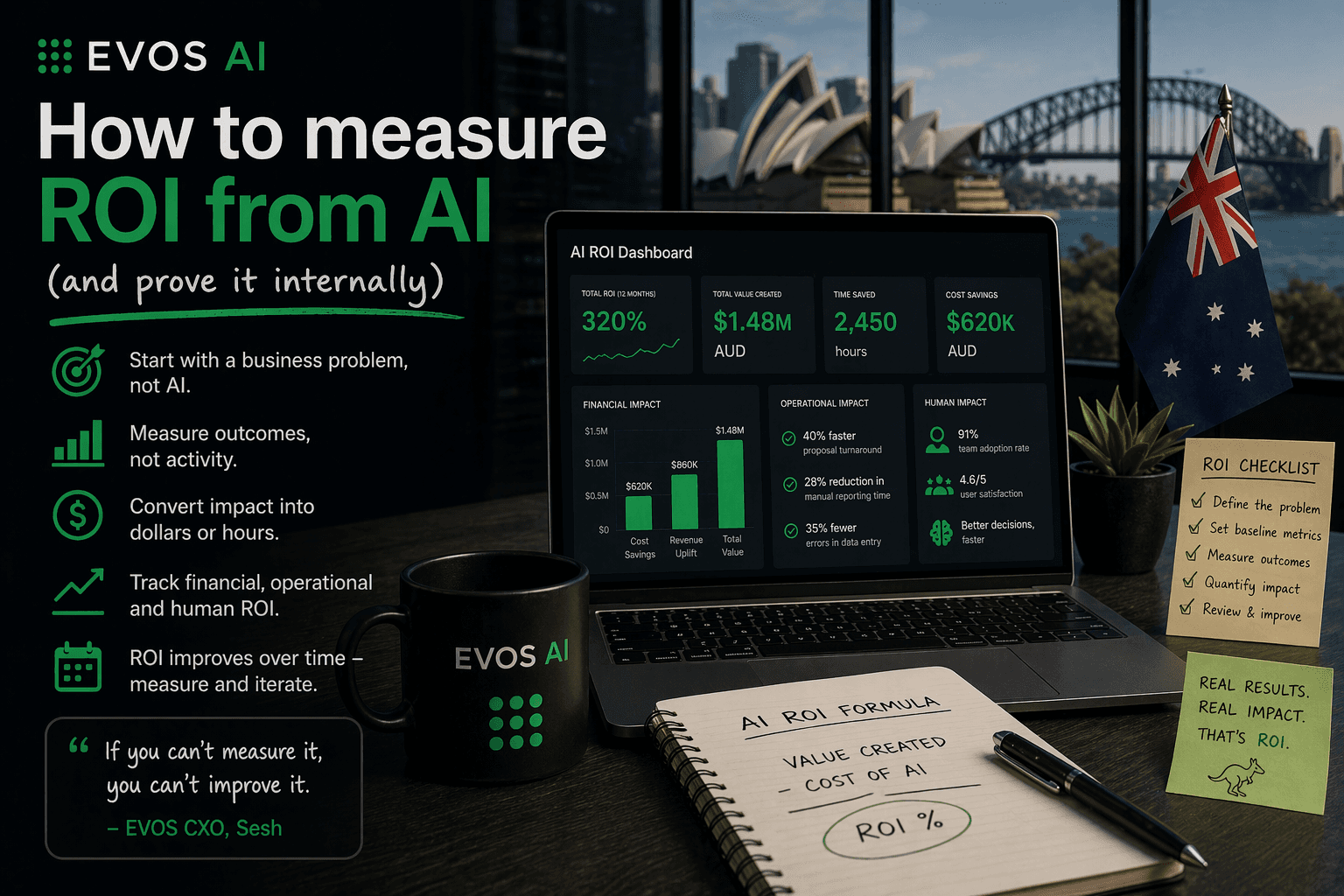
1. Start with a business problem, not AI
This is where most companies go wrong.
They start with:
“We want to use AI”
Instead of:
“We want to solve this specific problem”
Australian guidance consistently points to this as the first step — tying AI to real business outcomes, not just activity
Good examples:
Reduce customer support costs by 20%
Cut proposal writing time in half
Increase sales conversion rates
Bad example:
“Use AI in marketing”
If you can’t tie it to a measurable outcome, you won’t be able to measure ROI.
2. Measure outcomes, not activity
One of the biggest traps is what people call “vanity metrics.”
Things like:
Number of prompts
Number of users
Number of automations
They look good. They mean nothing.
What matters is:
Time saved
Revenue generated
Costs reduced
Or as one Australian guide puts it:
AI ROI should be measured by whether it’s solving real business problems — not just completing tasks
3. Convert everything into dollars or hours
This is where ROI becomes real.
You need to translate AI outcomes into something the business understands:
Hours saved → labour cost
Faster sales cycles → revenue
Fewer errors → cost avoided
Example:
If AI saves your team 10 hours per week
→ and your average cost per employee is $50/hour
→ that’s $500/week
→ $26,000/year
That’s ROI.
This approach is widely recommended — turning AI results into financial or operational metrics executives already trust
4. Set a baseline before you start
This sounds obvious. Most people skip it.
Before AI:
How long does the process take?
What does it cost?
What’s the error rate?
After AI:
Compare directly
This “before vs after” is one of the simplest and most effective ways to prove value
Without a baseline, you’re guessing.
5. Track three types of ROI (not just one)
Most businesses only look at financial ROI. That’s a mistake. The best-performing Australian companies track:
Financial
Cost savings
Revenue uplift
Operational
Productivity gains
Faster delivery
Fewer errors
Human impact
Employee adoption
Customer satisfaction
Decision quality
Because the reality is:
AI ROI isn’t just about profit — it’s about performance and capability improvement
6. Expect ROI to improve over time
AI isn’t like buying a machine and switching it on.
It improves as:
Teams adopt it
Workflows evolve
Data improves
In fact, many Australian businesses are seeing 200–400% ROI within 12–18 months when AI is properly implemented
7. Build ROI into your infrastructure (this is the real unlock)
Here’s the part most people miss.
You can’t measure ROI properly if:
You don’t control usage
You don’t control costs
You don’t have visibility
This is why so many AI projects feel vague.
You’re measuring outputs… without owning the system.
The shift happening now is this:
Businesses are moving from:
“Using AI tools”
To:
“Running AI infrastructure”
Because when you own the infrastructure:
Costs are predictable
Usage is measurable
ROI becomes clear
AI doesn’t fail because it doesn’t work. It fails because it’s not measured properly.
Or worse — it’s measured using metrics that don’t matter.
If you want AI to succeed in your business, focus on this:
Start with a real problem
Measure outcomes, not activity
Translate everything into dollars or time
Track impact across the business
Build systems that give you visibility
Because at the end of the day:
AI isn’t a tool experiment.
It’s a business investment.
And investments need to prove themselves.