There’s a narrative going around that AI is risky because it can leak your company’s financials or any other key documentation. That if someone internally uses AI to write reports, that data somehow becomes accessible to others outside the organisation.
It sounds plausible—but it’s not how these AI systems actually work.
Platforms like OpenAI,Gemini or any of the many others don’t operate like shared databases of user inputs.
They don’t allow someone else to query your company’s data, and they’re not learning your financials in real time.
So the idea that a competitor can extract your numbers from an AI model isn’t grounded in reality. At the moment.
But there is a real risk—and it’s much closer to home.
When businesses deploy AI internally—on top of tools like SharePoint or Google Drive—
the model becomes a layer over your existing data.
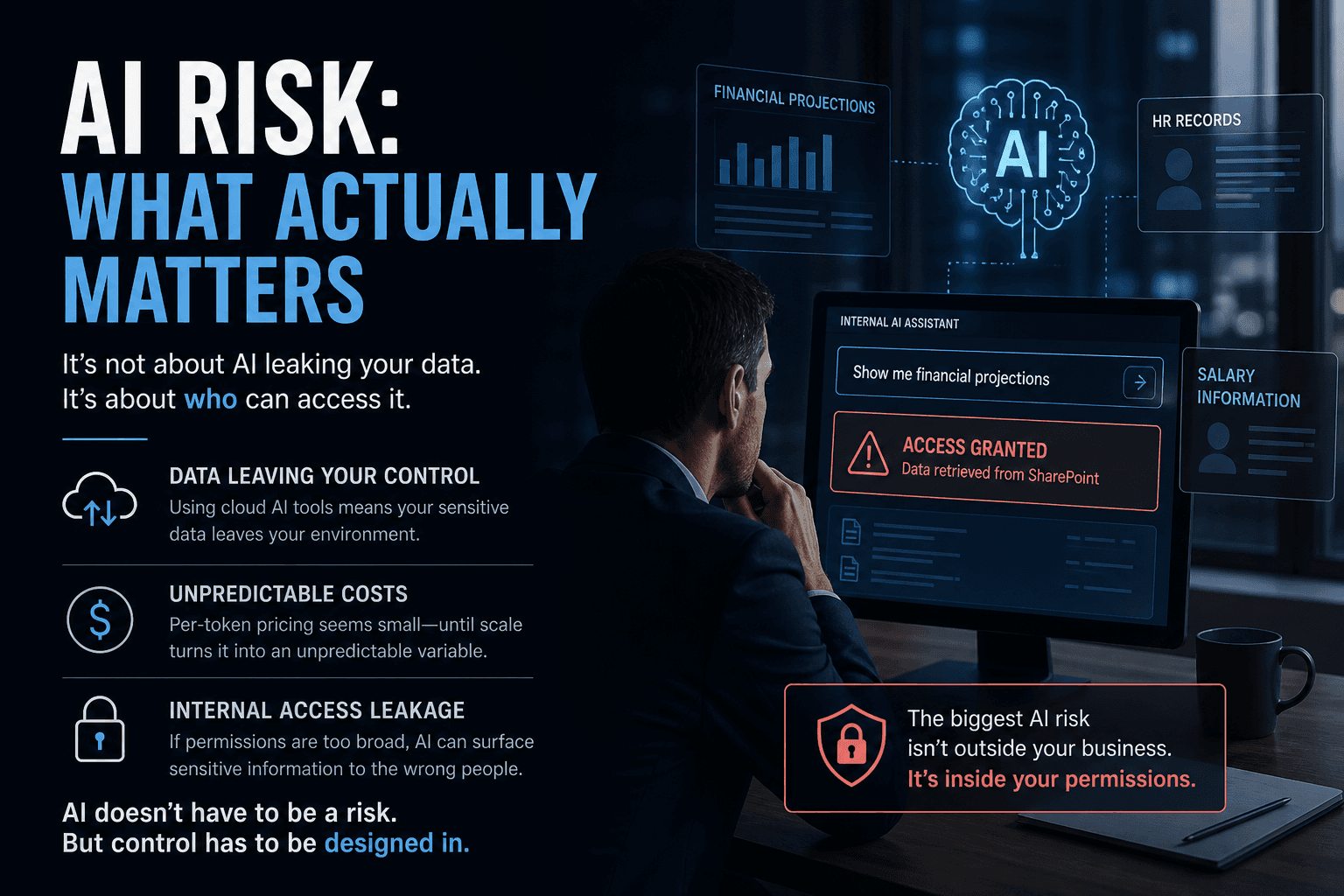
If permissions aren’t set correctly, the AI doesn’t know what’s “sensitive”—it just retrieves what it has access to.
So someone could ask:
“Show me financial projections.”
“Summarise salary bands.”
“Pull HR records.”
And the system might return information they were never meant to see.
This isn’t a model problem.
It’s a data governance problem.
And it’s far more likely than AI “leaking” your data externally.
When you use cloud AI, your data leaves your environment.
You lose control over:
where it’s processed
how it’s stored
and who ultimately has access
That’s the real issue.
The real shift with AI is this:
It changes how easily information can be accessed inside your business.
It’s not about AI exposing your data to the world.
It’s about making internal data easier to surface—sometimes to the wrong people.
And for most organisations, that’s the risk worth paying attention to